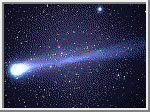

|
|
|
Comets Visible TonightThere was another sign in the Heaven, and behold a great red dragon... And his tail draweth a third part of the stars in Heaven. The Relevation of St John the Divine, 12.14
|
|
Astronomers are excited about a sungrazing comet discovered late in 2012. For a short time, it might become as bright as a full moon. That’ll be around the time of its perihelion – or closest approach to the sun – on November 28, 2013. This comet is called C/2012 S1 (ISON) by astronomers. All of us around the globe should be able to see it. Look below for a month-by-month Comet ISON viewing schedule. Comet ISON will come within 800,000 miles (1.2 million km) of our sun’s surface on November 28. That’s over 100 times closer to the sun than Earth. This close pass to the sun might cause Comet ISON to break to pieces. If it doesn’t break up, Comet ISON should become very bright. It might bright enough to see in daylight, near the sun, briefly. If it survives, it should go on to have a dazzling showing in December 2013.
Comet ISON month-by-month in late 2013.
August and September 2013. The comet should become visible in August and September 2013 to observers at dark locations using small telescopes or possibly even binoculars.
October 2013. Comet ISON should become visible to the unaided eye, but only barely in the early part of the month. The comet will be sweeping in front of the constellation Leo then. It’ll pass first near Leo’s brightest star Regulus, then near the planet Mars. Maybe these brighter objects will help you find it that month. Meanwhile, the comet itself will be getting brighter during October.
November 2013. Comet ISON will continue to brighten throughout the month as it nears its late November perihelion (closest point to our sun). Plus ISON will pass very close to the bright star Spica and the planet Saturn, both in the constellation Virgo. Its perihelion (closest point to our sun) on November 28 will be an exciting time. The comet will come within 800,000 miles (1.2 million km) of our sun’s surface. If all goes well, and the comet doesn’t break up (as comets sometimes do), the terrific heating Comet ISON will undergo when it’s closest to our parent star might turn the comet into a brilliant object. Some are predicting that ISON will become as bright as a full moon! That would make Comet ISON a daylight object, briefly. Remember, though, at perihelion, Comet ISON will appear close to the sun on the sky’s dome (only 4.4° north of the sun on November 28). Although the comet will be bright, you’ll need to look carefully to see it in the sun’s glare. Some expert help around this time might be called for, and we’ll announce comet-viewing parties as we hear about them.
December 2013. This may be the best month to see Comet ISON, assuming it has survived its close pass near the sun intact. The comet will be visible both in the evening sky after sunset and in the morning sky before sunrise. As ISON’s distance from the sun increases, it’ll grow dimmer. But, for a time, it should be as bright as our sky’s brightest planet, Venus, and it should have a long comet tail. People all over Earth will be able to see it, but it’ll be best seen from the Northern Hemisphere as 2013 draws to a close.
January 2014. Will ISON still be visible to the eye? Hopefully. And on January 8, 2014, the comet will lie only 2° from Polaris — the North Star.
How bright will it be? How long will its tail be? No one can answer these questions yet, but many are excited about this comet.
Who discovered Comet ISON? Eastern European and Russian astronomers announced the new comet on September 24, 2012. Discovery magnitude was 18.8 – in other words, extremely faint. Vitali Nevski of Vitebsk, Belarus and Artyom Novichonok of Kondopoga, Russia spotted the comet on CCD images obtained on September 21 with a 0.4-m f/3 Santel reflector of the International Scientific Optical Network (ISON) near Kislovodsk, Russia. Afterwards, astronomers at Remanzacco Observatory in Italy confirmed the comet’s presence with the image above.
No doubt about it … comets have a mystique. Once considered omens of doom, we now know them as icy visitors from the outer solar system that sweep near our sun, then disappear again into the depths of space, perhaps never to return. People get excited about comets. They are temporary visitors to our region of the solar system. This comet will be no exception. Of course, comets don’t always live up to expectations. Comet ISON might break up into fragments, as the much-hyped Comet Elenin did around August 2011.
On the other hand, Comet ISON might survive its encounter with the sun as Comet Lovejoy did in late 2011. If so, it might go on to illuminate our skies with its beauty. And there is one thing we can count on. That is, if Comet ISON does become a bright comet, visible to the eyes of watching earthlings, it will be beautiful. All bright comets are. If it does survive its close encounter with the sun in 2013, and if it does become bright enough to be seen with the eye, astronomers say Comet ISON’s best appearance won’t be limited to just one hemisphere as Comet Lovejoy’s was. It’ll be visible to all of us in both the Northern and Southern Hemispheres for at least a couple of months, from about November 2013 through January 2014. If so…worth the wait!
Bottom line: Comet C/2012 S1 (ISON) is headed for a close encounter with our sun in 2013 and might become a spectacular sight from all of Earth around November and December of this year. This post contains a month-by-month viewing guide, some history of the comet, and a word about what to expect from Comet ISON. - Comet PANSTARRS possibly visible to eye in March 2013..source: Earthsky
Exciting news!!!, a new comet has just been discovered which could turn into the greatest comet of our lifetime!. Comet C/2012 S1 (ISON) is currently magnitude 18 and beyond the orbit of Jupiter, however preliminary observations indicate that the comet will pass close to both the Sun and Earth during the latter half of 2013 when comet ISON could obtain a negative magnitude and become a great comet. In fact, serious calculations already predict a peak brightness anywhere between magnitude - 10 and -15 which is considerably brighter than a full Moon!!. Furthermore the comet could become visible in broad daylight close to the sun during late November!. During post perihelion the comet will move into the W evening sky during December and January when it will become a circumpolar object for observers at northern latitudes and become visible all night long during which time the comet could sport a vast dust tail, some experts have even speculated that the tail unfurled could be the longest ever recorded in history. The comet should be at its finest on Christmas Eve or Christmas night when it could be a truly spectacular sight in the night sky. The comet's nucleus is already intrinsically bright and large with closer investigation suggesting a possible link to the great sungrazing comet 1680. More recent news has confirmed that the comet will pass close to planet Mars during October of that year when its orbit could be perturbed so this bares close watching.
This comet has generated great excitement in the astronomical world and will be watched closely in the months ahead as comet observers all over the globe watch with much anticipation in the hope that ISON will put on a beautiful show. Further observations and accurate astrometric measurements will be made to verify the current orbital parameters, the big question is...is ISON a new Oort cloud comet or a previous visitor to our inner solar system? - if the former then the comet could become a damp squib and fizzle out or fragment as its virgin nucleus battles with its first taste of solar heat and stress, but if the latter is true then the odds are much more encouraging of getting a truly great comet. I for one have always wished to observe and photograph a proper great comet, the kind of comet in the history books - and if current predictions remain true then it looks like I might get to see a dream come true - a dream shared by many comet observers alive today. Stay tuned for updates...
Cbet nr. 3238, issued on 2012, September 24, announces the discovery of a new comet (discovery magnitude 18.8) by Vitali Nevski (Vitebsk, Belarus) and Artyom Novichonok (Kondopoga, Russia) on CCD images obtained on Sept. 21.06 UT with a 0.4-m f/3 Santel reflector of the International Scientific Optical Network (ISON) near Kislovodsk, Russia. The new comet has been designated C/2012 S1 (ISON). Comet C/2012 S1 (ISON) will get to within 0.012AU of the Sun (extremely close) at the end of November 2013 and then to ~0.4AU from Earth at the beginning of January 2014! According to its orbit, this comet might become a naked-eye object in the period November 2013 - January 2014. And it might reach a negative magnitude at the end of November 2013.
 |
(Above) View looking east on the morning of the 10th December 2013 05.00h with C/2012 S1 ISON rising tail first. Click on both charts to see larger versions.
 |
(Above) View looking west on the evening of the 18th December 2013. 16.00h. Both charts credit of Eagles Eye On The Sky by Dave Eagle.
''Some further thoughts and speculation on my part concerning the new comet. At the moment the most interesting aspect of this new object to me are the orbital elements' distinct and surprising similarity to those of the Great Comet of 1680. Let me point out that it would seem to me to be a virtual impossibility for this to be just pure coincidence. Let me explain further. Other than true Kreutz Sungrazers, other comets having a q even approaching 0.05 AU are so exceedingly rare that in all of cometary history their number can be counted on less than the fingers of one hand. That the two with by far the smallest recorded values of q should also share even somewhat similar values of L and B strictly by chance seems to me to be mind boggling. And while L and B would indeed result in a great separation in the position of the two comets near aphelion, at the time nearest perihelion passage the orbits may come quite close together and might even be found to cross as the elements of 2012 S1 become better refined (or perhaps those of the 1680 comet could be re-defined?)''
''The Great Comet of 1680 had a supposed e of 0.999986. Should comet 2012 S1 begin to show an e of anything less than 1.0 in coming months I think that the conclusion that the two comets are at least in some manner directly related becomes almost inescapable. Purely as speculation, perhaps the two bodies could have been one a few revolutions ago''...continued below
''Has anyone else noted, based on the current orbital elements, the exceedingly close approach that 2012 S1 will make to the planet Mars on, or about, 2013 October 3? Run JPL's Small-Body Orbital Diagrams program for a real surprise!, In addition, in examining the viewing circumstances for 2012 S1 immediately post perihelion, I would point out the possibility, based on the development of past major comets with perihelia less than 0.1 AU, together with the earth-comet-sun alignment of 2012 S1 during early to mid December of 2013, and assuming a typical rate of dust production, that the dust tail generated by 2012 S1 might be among the longest ever recorded''...J. Bortle
Latest thoughts of L4's dust tail by comet expert John Bortle...
''Further addressing the question of the appearance of C/2011 L4's dust tail, in examining the viewing circumstance for this comet during its coming apparition an interesting situation is apparent. For several weeks either side of the perihelion passage any dust tail will be presented nearly face-on to the Earth. This will cause its appearance to be essentially undistorted by projection circumstances and therefore displaying the maximum degree of real curvature. Thus, how the dust tail will look as viewed from Earth with the naked eye can have many potential possibilities totally dependent on the distribution of mass/ejection velocities of dust particles from the nucleus. Likewise, if there happens to be a very broad distribution of these dust particle sizes, then the tail is likely to be very wide and have a lower surface brightness than might be otherwise anticipated for a comet of such high intrinsic brightness. To a degree, this was the case with P/Halley in 1986 shortly after its perihelion passage. Conversely, if a comet's dust tail happens to be seen nearly edge-on it can be very bright indeed, as many here are probably already aware.
Regardless, a few things do seem fairly certain. Any nakedeye dust tail that is seen in all likelihood will be rather dramatically curved and lag the direction of the ion tail (the ERV) by many degrees. I would even speculate that Comet PANSTARRS' appearance next February/March - assuming that it evolves as currently hoped - could perhaps be somewhat like that of Comet Donati in September of 1858 (although not of such great length), if the range
in dust particle size''
 |
(Above) View looking east on the evening of the 6th of April 2013. 20.00h, click charts to enlarge
 |
(Above) View looking east on the morning of the 7th of April 2013. 04.00h. Both charts credit of Eagles Eye On The Sky by Dave Eagle.
I know this is a little early however I can't help getting excited about the possibility of seeing a 'great comet' during the Spring of 2013 and according to the latest data the odds are looking good of getting a spectacular show if the current conditions continue as they are. A comet designated C/2011 L4 PanSTARRS was discovered by the PanSTARRS NEO sky survey during June 6th 2011 and subsequent orbital calculations began to get astronomers very excited indeed.
It turns out that the comet was discovered very far from the sun at a vast distance of 7.9 Astronomical Units (A.U) making it similar in ways to Hale-Bopp back in 1997. However it gets even more interesting as latest observations indicate that the comet is quite large and very active sporting large concentrations of dust and recent CCD images already show the comet slightly brighter than expected with a coma and tail which bodes extremely well for a good show in 2013. The comet has a parabolic orbit with its origins within the Oort Cloud which means this will be its first and last trip into the inner solar system so this will be a once in a life time apparition. The comet will pass closest to Earth on March 5th 2013 at 1.10 AU and closest to the sun (perihelion) on March 10th 2013 at 0.30 AU which is as close to the sun as planet Mercury.
So what does all this mean?, if L4 PanSTARRS continues to brighten as predicted then we could have a bright naked eye comet (mag 0 to -1.0) visible in the northern hemisphere evening sky low in the west after sunset moving higher each night during March 2013 from Pisces into Pegasus/Andromeda perhaps sporting a bright naked eye dust tail, it will even be circumpolar during April while fading. The comet could be very photogenic and located within the same camera field as the waxing crescent moon, zodiacal light, and not far from M31, and because 2013 is predicted to be solar maximum we could have a comet and aurora visible at the same time. Comets are extremely unpredictable and can go into outburst in which case PanSTARRS could brighten even further, however for the moment all this is speculation, new Oort cloud comets have a habit of showing rapid early brightness then fading however the opposite can also occur. The truth is that no one knows for sure what will happen until March 2013 and as comet discoverer David Levy once said - ''comets are like cats, they have tails and do precisely what they want''.
Comet |
Mag |
Dia |
D.C |
Sky (55 *N) |
Trend |
Comments |
C/2011 L4 PanSTARRS |
8.0 |
5' |
5 |
Visible ( S) |
Brightening |
Great Comet March 2013? |
| C/2012 S1 ISON | 16.0 |
- |
- |
Visible (N & S) |
Brightening |
Great Daylight Comet 2013? |
Make sure to check out the 'Sky Events' page as I regularly feature one or more of the current comets in more detail with images, sketches, and visual reports from myself and other readers.
Martin McKenna